Considerations from an IT Perspective
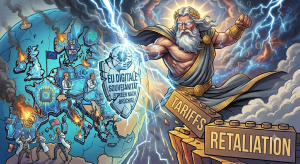
Does the headline appear contradictory? It is not. Following the Trump inauguration in January 2025, a shockwave impacted both the EU and NATO. The transatlantic partnership, which served as a guarantor of stability and security for roughly 70 years, was abruptly terminated. Europeans were (and still are) downgraded to an adversarial status, perceived by the new administration as parasites and free-riders. This approach recalls the ’shock and awe‘ strategy from the Second Iraq War (2003), which sought to dismantle the adversary’s resolve. This objective was not achieved in Europe. In the meantime, ’shock and awe‘ has evolved into ‚fight and resist‘. This is especially true in the tech sector, where dependencies are huge and sovereignty critical. And likewise, Europeans must admit that we made ourselves far too comfortable for far too long.
Tech Sovereignty. - What happened so far.
In the field of IT, numerous laws and regulations have been enacted by the EU Commission. Seems like we have heard the "trumpets". They can be classified into the following categories:
- Hardware & Infrastructure: Semiconductors and Data Centers
- Software & AI: Open Standards instead of Monopolies
- Regulation of the Platform Economy: Breaking Market Power
- Cybersecurity and Supply Chain: Building Resilience
Despite significant threats from Washington – which have increased disproportionately since 2025 – the EU is maintaining its strategy of de-risking technological dependencies. This applies primarily to the USA, but also to China. Better late than never… .
No more Complaining, no more Lamentation

Consequently, complaining and lamentation on our continent did gradually cease and give way to a regained self-confidence. Europe can be proud of what it has achieved over the past 70 years, considering that we went to war with each other in the past, rather than cooperating. A successful peace initiative like the EU is unique worldwide. In any case, I am proud to be a European, without falling into the profound folly of becoming anti-American. I spent my professional life working for IT-companies, both inside and outside the US, and I know there is a lot more to America than what we currently see. The times they are a-changin’, as Bob Dylan put it, and we must not throw the baby out with the bathwater. However, we require technological sovereignty; current politics continuously demonstrate how vulnerable we are to coercion. Interdependence is acceptable because it is mutual; dependency is unacceptable because it is unilateral and induces weakness.
Built in Europe

Very recently I came across an initiative which illustrates how the pursuit of greater independence is moving beyond the offices of the EU Commission and European governments into the world of private IT startups. I am talking about the "Built in Europe" initiative supported by successful European home-growns like Revolut, Mistral, Wayve, and ElevenLabs. – And more than 100 European founders and CEOs have since joined. The initiative is driven and supported by the European investor Balderton. The core concept: to scale globally, relocating to Silicon Valley is no longer mandatory. Even though much remains to be done, particularly regarding capital availability. Personally, I observe that startups and young companies from other continents, which my company Go Europe Consulting assists in establishing a presence on our continent, no longer reflexively reject the idea of a European presence prior to moving to the USA.
Thank you, Donald, for making all of this possible. Without you, it would have taken so much longer (seriously) — and meant far less.